Commercial roof leak repair in Owensboro covers offices, retail shops, restaurants, and warehouses, and each of those buildings uses its roof differently. An office worries about stained ceiling tiles and damp air over workstations. A restaurant worries about a drip over a kitchen or a dining room during service. A warehouse worries about water over stock and racking. The leak itself may be the same — a failed seam, a blocked drain, a lifted edge — but the plan around it has to fit the business underneath.
Most commercial roofs in Daviess County are flat or low-slope, which changes how leaks behave. Water does not run off quickly; it ponds, spreads, and finds the weakest seam or drain. Tracing a commercial leak means working across a large, mostly level surface, checking drains and edge metal as carefully as the membrane itself, and writing a scope that a building owner or manager can follow section by section.
Offices, retail, restaurants, warehouses: different stakes
Four kinds of building, four kinds of urgency. In an office, a leak over a workstation is a disruption and a health concern if damp ceiling tiles stay in place. In retail, a drip over a sales floor is visible to customers and can damage stock on display. In a restaurant, a leak near food preparation or dining areas raises hygiene questions that go beyond the roof itself. In a warehouse, the risk is quieter and larger: water over racking can damage stored goods before anyone notices a stain on a high ceiling.
A commercial repair visit starts by asking how the space below is used, not just where the stain is. That answer decides where temporary protection goes first, which areas need to be kept clear, and whether work should be phased so the busiest parts of the building are repaired outside peak hours. A scope that ignores the business underneath the roof is a scope that will cause a second problem while fixing the first.
Flat and low-slope membranes, drains, and edge metal
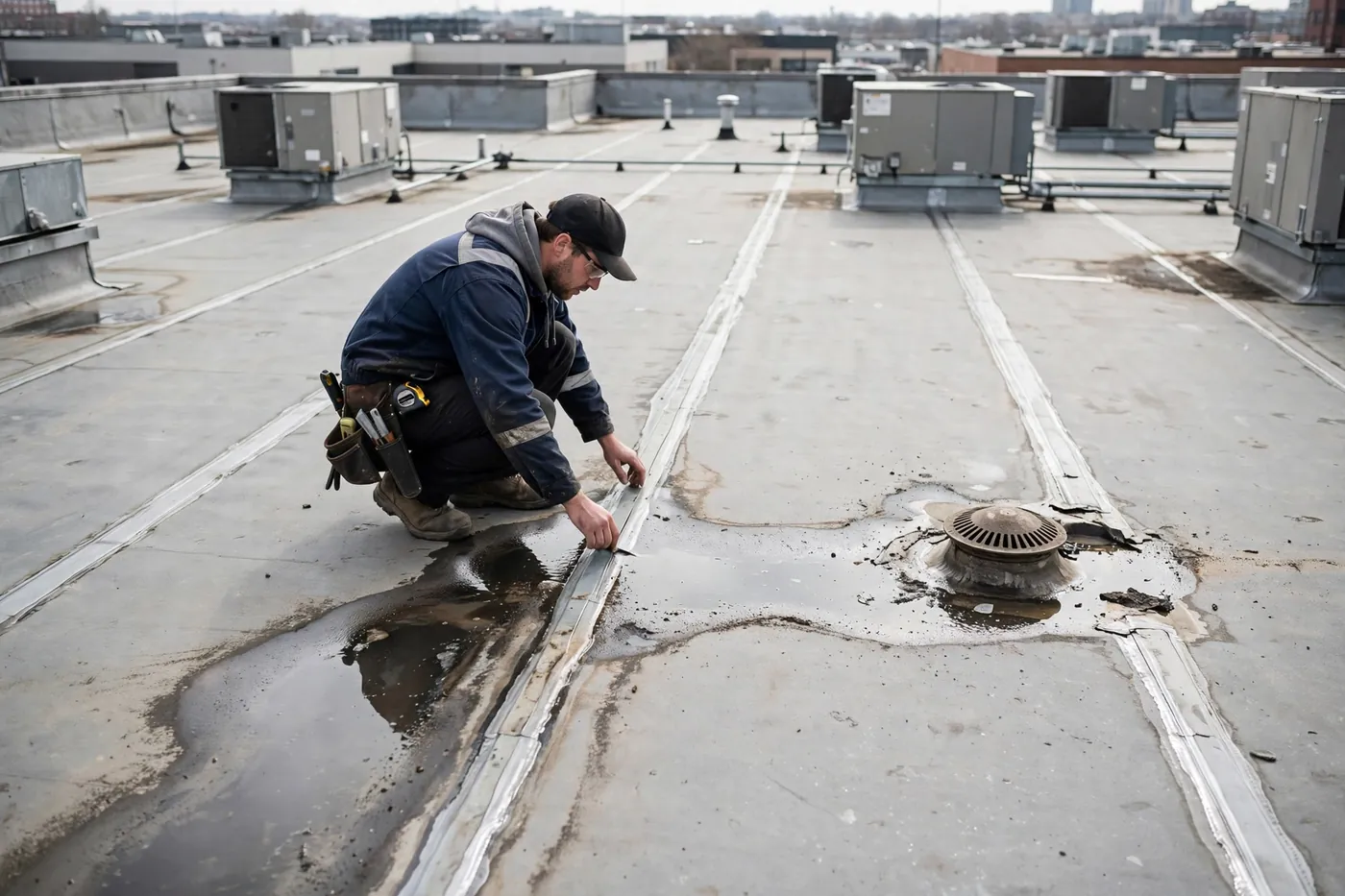
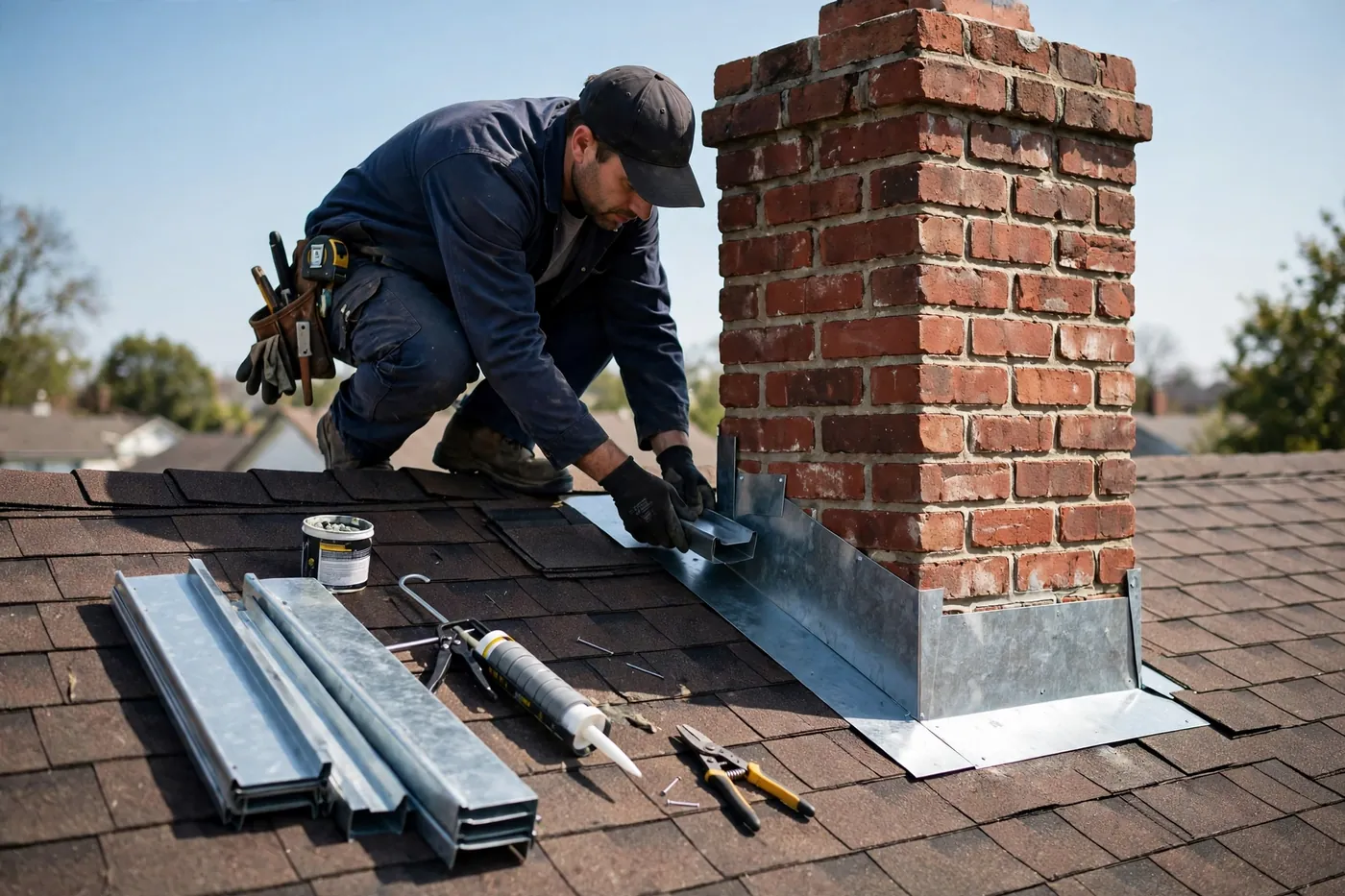
Flat and low-slope roofs rely on a membrane — a continuous sheet or a set of welded or adhered seams — rather than overlapping shingles. Water sheds slowly, so the membrane, its seams, and its edge details carry the whole job. Seams open with thermal movement and age. Flashing at parapet walls cracks where the membrane meets a vertical surface. Penetrations for vents, pipes, and HVAC curbs each need their own flashing detail, and each is a potential entry point.
Drains are the other half of the system, and they are often the actual cause of a leak that looks like a membrane failure. A blocked drain turns a flat roof into a shallow pond, and ponding water pushes against every seam and flashing detail at once. A commercial leak check therefore starts with drains and scuppers: are they clear, do they drain to the right place, and is water standing anywhere on the roof after rain? Fixing a seam while leaving a blocked drain in place invites the same leak at the next heavy downpour, which in the Green River region is never far away.
- Seams open with thermal movement; parapet and curb flashing crack at vertical joints
- Blocked drains turn a flat roof into a pond that stresses every seam at once
- Edge metal protects the perimeter, and a lifted edge lets wind and water under the membrane
- A drain check comes before a membrane repair, not after it
Phased work that keeps the building open
Phased scheduling is how a large commercial roof gets repaired without shutting the building down. The roof is divided into sections, and each section is opened, repaired, and made watertight before the next section is touched. That way a sudden storm during the job only threatens the section currently open, not the whole roof. Phasing also lets work move around the business: a restaurant dining room repaired outside service hours, a retail floor sectioned off aisle by aisle, a warehouse bay cleared in turn.
The phasing plan belongs in the written scope, not in a verbal understanding. It should name the sections, the order of work, what interior protection is in place for each section, and what happens if weather interrupts the schedule. For a building with tenants, the same plan gives the property manager something concrete to share, so tenants know which areas are affected and when, instead of hearing about roof work through a drip in their own space.
Tracing a leak across a large, level roof
Tracing a leak across a large flat roof is a different skill from tracing one on a house. On a house, the attic gives a map of the wet path. On a commercial building, the ceiling may be far below the roof, with ductwork and decking in between, and the stain may be far from the entry point because water spreads across a level deck before it finds a seam to drop through. The check therefore works from the roof down: drains, seams, edge metal, and penetrations first, then the interior pattern of stains matched against the roof layout above.
Ohio River humidity adds a complication that is easy to miss on a commercial roof. Condensation inside a large, poorly ventilated roof assembly can stain ceiling tiles in the same way a membrane leak does, especially in winter when warm indoor air meets a cold deck. A repair visit should separate condensation from a genuine membrane failure before cutting into the roof, because sealing a membrane that was never leaking leaves the moisture problem running and the ceiling tiles staining again.
Paperwork, permits, and a section-by-section scope
Commercial work brings paperwork that a homeowner rarely has to think about. Kentucky has no state roofer licence, so a licence number is not a useful check on its own. More useful is the written scope: the roof broken into sections, each repair named, the membrane and flashing involved, and the phasing plan. On commercial work, the KRS workers' compensation affidavit is also part of that paperwork, and it is worth asking about before work starts rather than after an incident on site.
Larger commercial scopes may involve Owensboro Metropolitan Planning Commission permits, particularly when decking or structure is replaced. That question, like the phasing plan, belongs in the scope at the start. Cost factors on a commercial job follow the same logic as the scope: roof size and number of leak points, membrane type, drain and edge-metal condition, interior protection needs, and whether work must be phased around operating hours. A scope that breaks the roof into sections makes each of those factors visible, so a building owner can see what each part of the job involves.